
Like everyone else who doesn’t live under a rock (and probably some that do), I saw the recent Nathan Fielder documentary on Elizabeth Holmes, You Can See Everything. Notwithstanding the fact that (spoiler, and there are more ahead) you still don’t know more than you did before about the details of her failed billion-dollar venture, I felt there was some truth to the title after all, even though it’s meant to be an ironic joke.
As I watched, the question of whether or not she was truly guilty became less and less interesting. What struck me more than anything else about Holmes was her way of viewing the world and the very specific blinders afflicting her experience, which may have ultimately led her to her current circumstances.
(All of this is assuming she’s not acting this way in the documentary on purpose to mislead us. If she is, as Amanda Seyfried remarked in the movie, we deserve to be fooled and all this is moot.)
One of the most telling scenes in the movie is where Nathan shows Elizabeth the clip of the comedians and their “Who’s on first?” joke, the punchline being that ‘Who’ is the name of the player which one person knows, but to the other person, it just sounds like they’re repeating the same question over and over again. It’s a play on the multiple meanings of a word, on context, and the humour of watching two people talk past each other, unable to grasp the reality of the other, as obvious as it seems to us, the third party.
In this clip, Elizabeth at first seems to jive with the joke, smiling at the right times and saying that it’s funny, before Nathan interrogates her on why it is. The more he pushes, the more she gets visibly frustrated that she doesn’t actually understand it. She is unable to grasp the two different contexts of each of the participants, she can’t see how each person is experiencing two separate realities that differ only slightly but in one crucial way.
In another scene where Nathan is asking her details about her invention, something truly odd struck me. As I watched her speak (although it was more like fumbling through the words), I was reminded of the stories of split-brain patients. In these patients, the fibres connecting the two hemispheres is cut, so if you split someone’s field of vision, there’s no way for the right hemisphere (which is mute) to communicate what it saw to the left. The left hemisphere, missing crucial context, simply makes up an answer that sounds plausible.
Confabulation is a phenomenon that happens when the left half of the brain is confronted with a reality it’s never seen before, so it makes up any plausible-sounding lie to fit the new data within its framework of reality. Crucially, although to us it’s obviously a lie, the person saying it believes it to be true to the very core of their being.
Nathan asks Elizabeth, “what do you think lying is?” She replies, “Saying something that I don’t believe to be true” (emphasis mine).
I in turn, believed that everything Elizabeth said, she sincerely believed it to be true. It doesn’t change the fact that she (with her partners) defrauded investors of a lot of money and made claims that weren’t factually true. But the tragedy of Elizabeth is that she truly doesn’t see how the story her brain is making up is just that— made up.
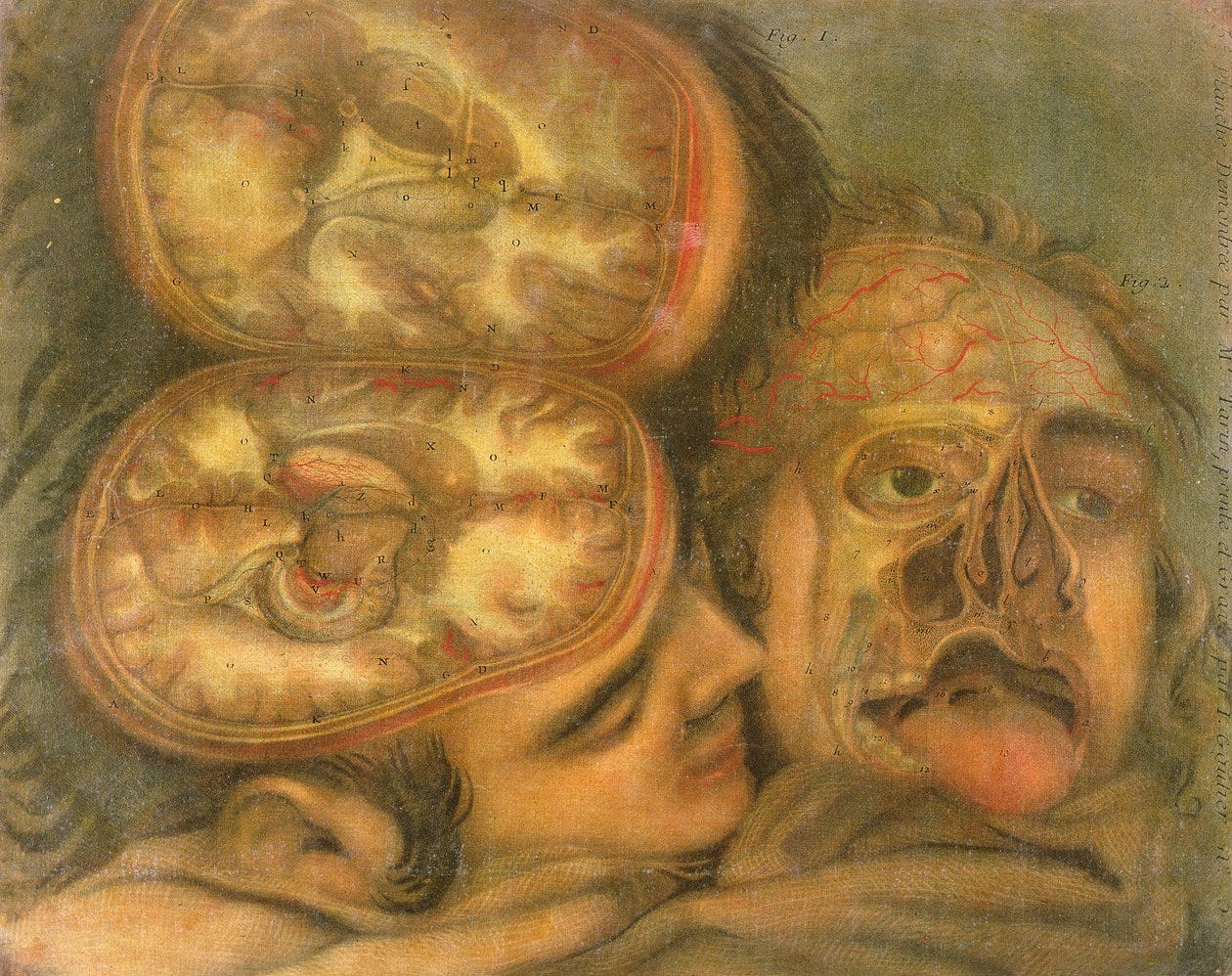
In Master and the Emissary, Iain McGilchrist puts forward a discipline-spanning and paradigm-shifting argument that the history of humanity is a story of the shifting balance between brain hemispheres.
After lamenting the neglect and dismissal the field of hemispheric lateralization has suffered in the scientific world, McGilchrist (psychiatrist, philosopher, English major) describes how the hemispheres don’t simply differ in their functions, but how their ways of seeing, processing and acting upon the world are fundamentally different.
The right hemisphere grasps the whole, understands humour, metaphor, what is implicit or unsaid yet obvious from context. It connects us to our bodies to make it seem like our bodies are in fact, our own bodies and it’s not someone else piloting our arms. It makes the people and world around us seem alive and real, it stitches together the events of our lives to create a coherent narrative and story about where we came from, who we are, and where we might go next. Simply put, it grounds us in the experience of being a thinking, feeling, observing human going through life. However, it is mute, and must send its context-rich impressions, observations and judgments to the left to communicate on its behalf.
On the other hand (brain?) the left hemisphere deals mainly in abstractions and representations. It takes the real-world data sent to it by the right hemisphere and strips it of its context, to find generalizations, breaks it down into its components and sees the world in how it can be used. Think of your left hemisphere as playing an animated video game reconstructed and transformed from sense data, and in this game, its aims are purely instrumental; to use and optimize. From the left hemisphere comes our language, formal logic, and our propensity to make tools out of just about anything in order to deftly manipulate our surroundings. The left is engaged with the mission of asserting ourselves in our environment, finding uses for it, achieving its goals of power and mastery; to win the game. [1]
In people in whom the corpus callosum has been cut (the central bundle of nerve fibres connecting the two hemispheres, severed usually to stop intractable seizures that start on one side and spread throughout the brain), the balance is disturbed. The two hemispheres aren’t completely separated, as they are still connected through the lower regions of their limbic system, but in carefully controlled tests designed to obfuscate certain sense data from one side, the deficiency becomes clear.
One thing to note about the left hemisphere is that it’s epistemologically arrogant. It thinks that whatever it’s decided is true. There’s no nuance or context to muddy up its convictions. Confabulation is a purely left-hemisphere function; it will make up whatever narrative fits the cues it’s given, no matter how outlandish or untrue, and moreover, it will absolutely believe that narrative to be true.
So in split-brain patients, you carefully split their field of vision so each hemisphere only sees one half, with no way to access the contents of the other half. Let’s say you show the right hemisphere a photo of a garden, and to the left hemisphere a photo of a kitchen. The left hand, connected to the right hemisphere, chooses the matching card showing a hoe. Now you ask the person why they chose that card. Speech lives in the left hemisphere but it’s missing the true context of why the left hand chose the picture of the hoe in response to what it saw, a kitchen. So it makes up a story it can use to make everything make internal sense: I chose the hoe because I keep my gardening tools in my kitchen (or some such absurd story). The crucial point is that the patient will 100% believe that story.
There’s something about left hemisphere dominance (or right hemisphere weakness) that seems to characterize some of our most famous modern figures, who have been canonized for never giving up, always sticking to their guns, no matter how much the people around them told them they were wrong….even if they were in fact, wrong. Journalist Geoffrey Cain reports the following about Steve Jobs on his conviction that they would sell 25,000 units of the ultimately failed NeXT computer in the next year, despite having no distribution network to speak of:
I think he actually believed it. I think that he did say things that he did not know for sure to be true, but I don’t think he ever saw himself as outright lying. Here’s what I learned about his reality distortion field, and this is what made it so dangerous. It wasn’t just about convincing other people that his ideas were infallible.
It was also about convincing himself. And he would listen to people sometimes, but other times, if it clashed too much with his vision, he would dismiss them. His biggest fault was building a monument to his own genius, his own vision, and thinking that that would be enough….
Elizabeth Holmes, on sheer (what I would call borrowed) audacity, convinced some of the most powerful people in the country to invest millions in her business, regardless of whether she even had a working product. The initial version of this story is that she was lying out of her ass constantly, rubbing her hands together in glee, like a cartoon villain, that these rubes were all falling for it.
After having seen You Can See Everything and all the ways in which Elizabeth just seems ‘off’ and disconnected from the mainstream undercurrent of the implicit that the rest of us are tapped into, it seems to me that she was simply reflecting the grandiose ambitions of the people around her, taking in the hype around her and effortlessly building a narrative that lived up to that hype. No, she wasn’t telling the truth. But she never thought for a second that she wasn’t.
No one more than me wishes this wasn’t simply another story of, helpless girl gets taken advantage of by a malicious, powerful man. But some things are cliche because they are so commonplace and in that vein, they are tragic.
I was discussing the movie with a friend, who had a similar interpretation of the movie and therefore of Elizabeth as I did and moreover, who said brought to mind another friend of hers. She recounted how this other friend (let’s call her Ellie) once told her a story of how she got in a car accident. Someone had spilled acid on her tires, dissolving the tread. On her hour-long drive home, she saw a ghost and had to swerve to avoid it. Because the tread on her tires were gone, she lost control of her car and that was how the accident happened. Rather than tell what was more likely to be the truth (perhaps she simply wasn’t paying attention), she applied a narrative that suited her better, i.e., none of it was her fault.
Ellie has also been in a string of abusive relationships, each of which she would defend. Her current partner cuts her off from money and uses it to control her; she justifies it by saying she never cared about money and she’s happy to have him deal with it (another reminiscent detail of Elizabeth saying something similar about Billy and how she’s never cared about money).
Confabulation, suggestibility, and an inability to see past appearances and the literal. All of these are hallmark signals of the imbalance between the left and right hemispheres. According to McGilchrist, left hemisphere dominance is also likely to be the cause of schizophrenia and schizotypal personality disorders, which are characterized by social detachment, aloofness, and poor insight and judgment. It is the last point that is particularly telling about Elizabeth’s predicament. She simply lacks the ability to judge others correctly, trusting the wrong people, making the wrong decisions, which ultimately landed her in jail.
In some ways, the documentary changed nothing at all; she’s still guilty, she’s still in jail, she still owes millions in restitution. In other ways, it may change everything; the context about why she might have done the things she did, her own internal state and true conviction that she did nothing wrong, the tragedy in her inability to see the big picture of her own life.
Although I do have graduate training in neuroscience, I’m not a psychiatrist or a forensic profiler. I have no credentials with which to ‘diagnose’ Elizabeth Holmes based on a documentary. Regardless, everything I know and have learned about hemispheric lateralization, the implicit cues and context I absorbed through the movie, my own frustrating experiences with other women whose entire personalities are Stockholm Syndrome, have all come together to completely change my mind about her and perhaps, feel some degree of pity and sympathy for her plight. It makes me wish that her father was indeed right when he predicted the true story about Elizabeth will come out and exonerate her eventually.
In a healthy, balanced brain, there is a constant two-way flow of information. The left receives data from the right, analyzes it in its instrumental way, and sends it back to the right, which uses this information to update and enrich its reality and goals. Poetry is a grand example of the two hemispheres working in concert: the left hemisphere finding the words and forms to communicate the contextually rich, implicit layers of meaning and metaphors formed by the right. There is nothing to indicate that there isn’t a solid, singular identity of a person behind their eyes, that their actions and words aren’t the result of two very different brains cooperating.